Chapter 1 of 12
Read this chapter as text
All 11 steps of this chapter, written out on one page. The activities and some pictures aren’t included: to see them, open a step in the lesson.
Step 1 Let’s start together.
American Mah Jongg is a tile game you play with other people. You build patterns, make choices and learn plenty together.
It’s a version of Mahjong played with 152 tiles, including Jokers, and a card that lists the winning hands. How do you say it? You’ll hear “mah-ZHONG” and “mah-JONG”. Dictionaries list both, so either is fine.
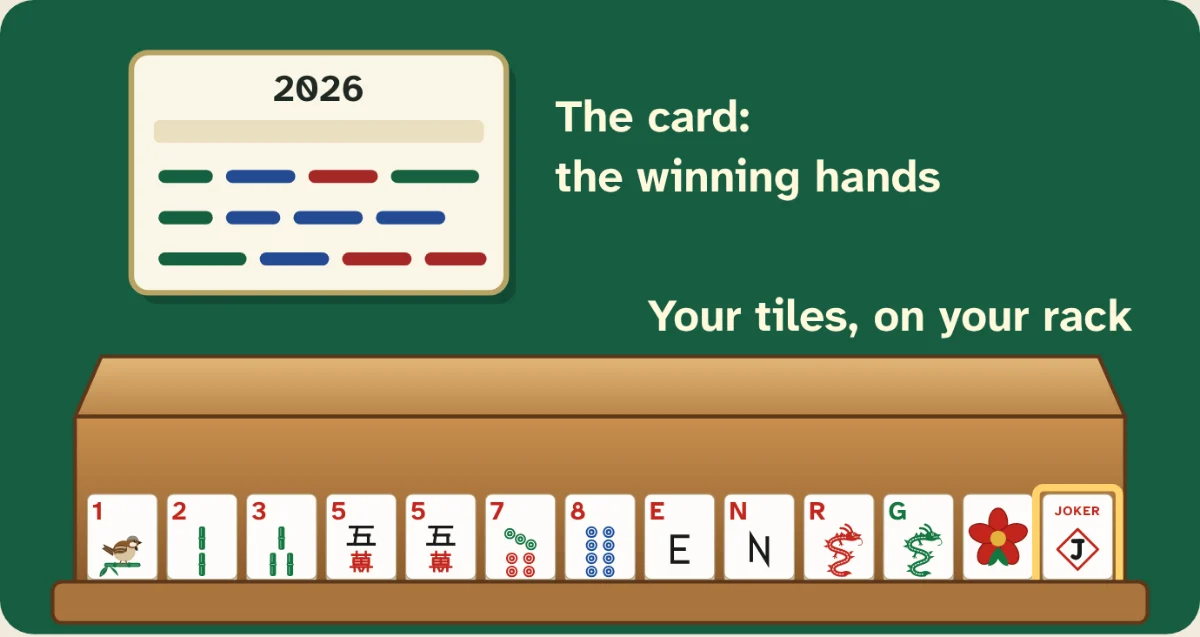
You can start without knowing any rules or owning a set. This chapter shows you the game, its equipment and the chapters ahead.
Your goal here
Learn what the game is and what you’ll play with.
What you’ll need
Only this tutorial. Go at whatever pace suits you.
Across 12 chapters, you’ll go from naming tiles to reading the card, setting up, trading and playing. In Chapter 9 you put it all together in a guided game. Chapters 11 and 12 cover advanced strategy.
Take it step by step
Some words will be new to you. We’ll explain each one when you need it. Nobody expects you to remember every rule the first time you see it.
Use Next to move on and Back to look again at any time. Chapter contents lets you find any step. Longer chapters are split into sections; the list under each chapter title shows which section you are in.
Step 2 About American Mah Jongg
In the usual game, 4 players sit around a table and gather tiles to form a winning combination.
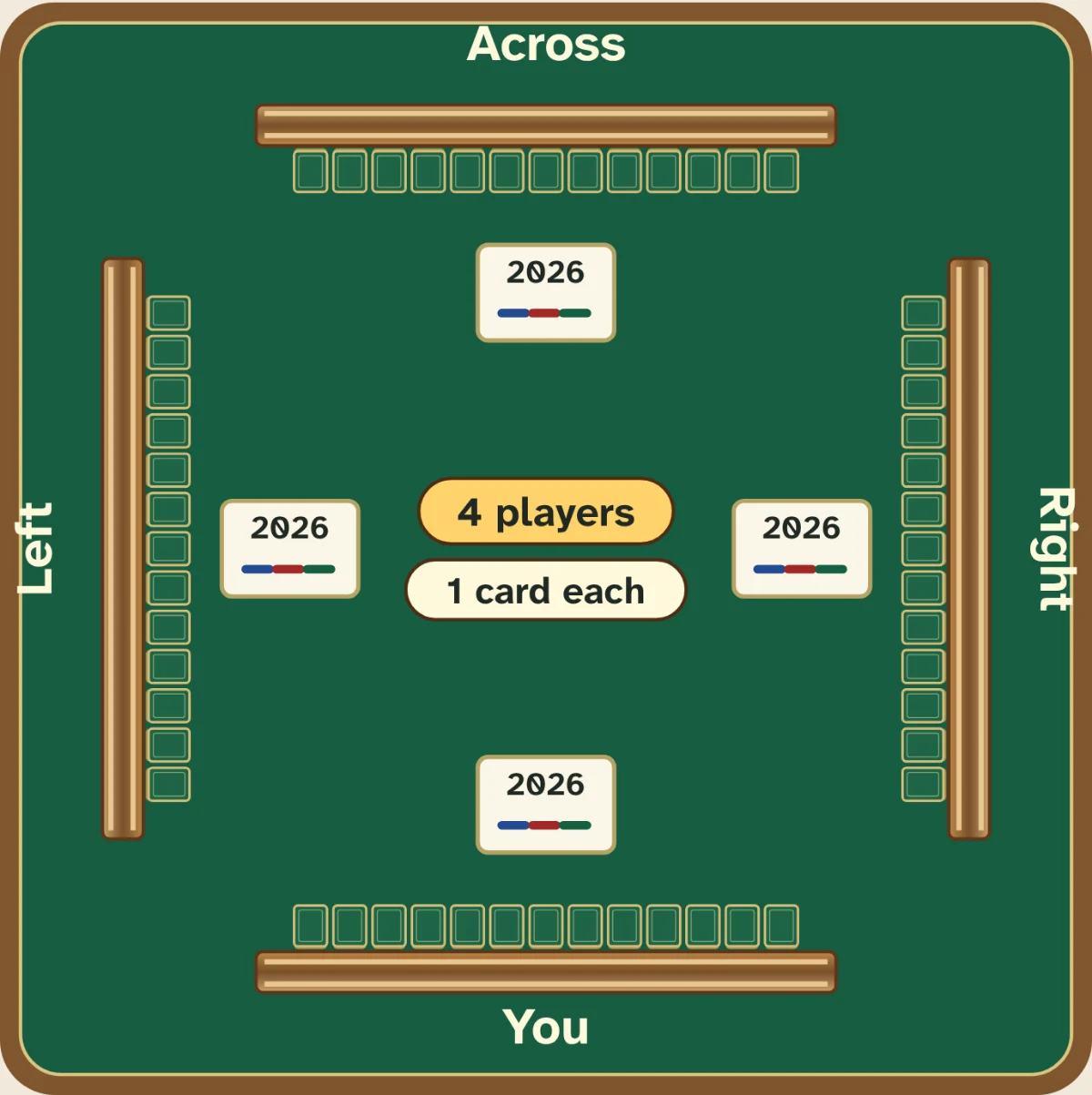
American Mah Jongg is one version of Mahjong. You’ll meet 3 features here that help set it apart:
- A card listing winning patterns
If you play by National Mah Jongg League rules, the League issues a new card every year. Each pattern shows which tiles make a winning hand. You keep the card next to you to check as you play. A trade before play begins
The Charleston is a set routine for trading tiles with the other players before ordinary turns start. It gives you a chance to improve your starting tiles.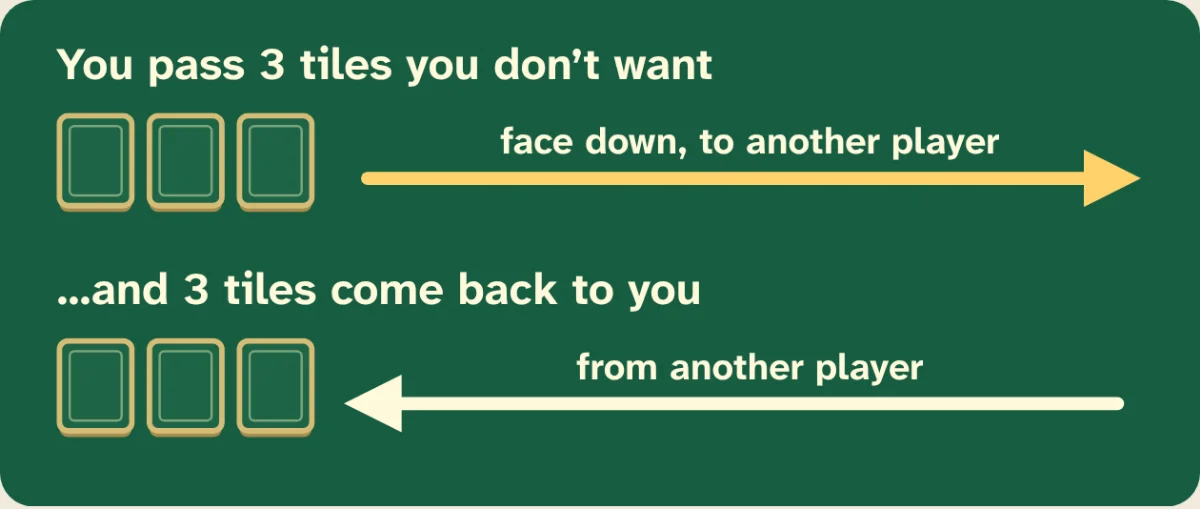
In the Charleston you pass 3 tiles you don’t want, face down, and get 3 tiles back. Jokers
These special tiles can stand in for other tiles in certain groups. They have limits, and we’ll cover those before you use them.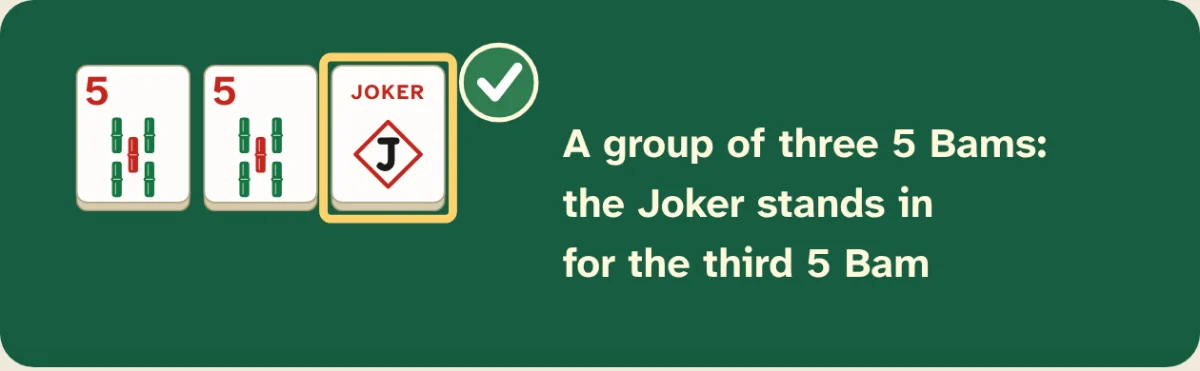
A Joker standing in for a third 5 Bam. Chapter 7 shows where Jokers can and can’t go.
Groups often play several games in one session. A group that plays together often may finish a game in about 15–30 minutes. A game played while you’re learning can take longer.
Step 3 In the usual game, how many people play?
Use this question to check what you’ve just learned. You can have another try.
You can use Back to read the explanation again.
Step 4 Get to know the equipment
First, let’s name the things you’ll play with. This is a quick introduction; Chapter 2 looks at the tiles more closely.
The set of tiles
American Mah Jongg is played with 152 tiles. Below you’ll see one example from each of the 7 tile families.
Tap or click each tile to learn about its family. All the tiles appear at the same size.
Your rack
A rack is a long stand that holds your tiles. They sit on its front ledge and lean back on the sloping face, pictures toward you, so the other players can’t see them.
An empty rack, seen from where the player sits. Racks are made in many materials and colors.
The flat top is for groups of tiles you show to everyone during certain moves. We’ll explain those moves later.
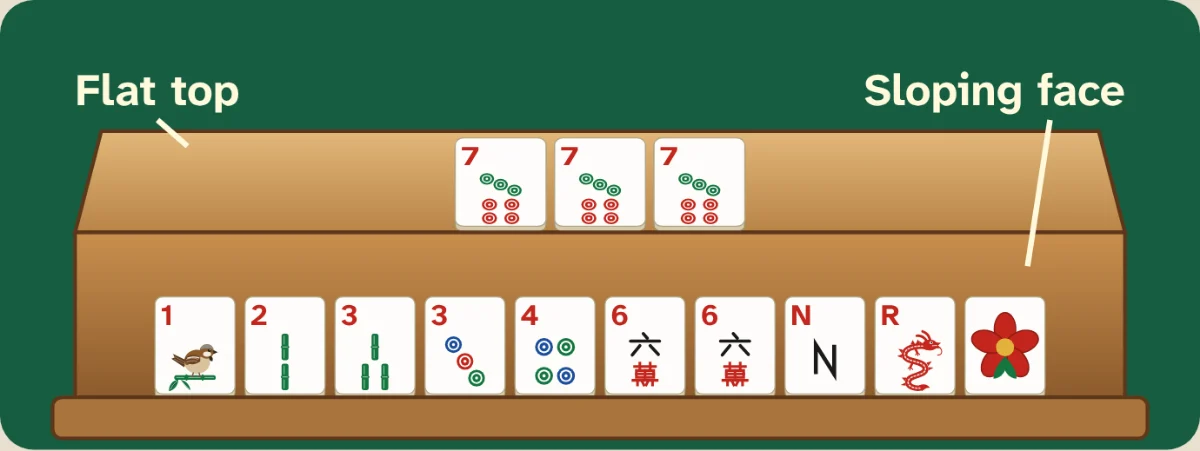
The NMJL card
The National Mah Jongg League (NMJL) card shows that year’s winning tile patterns. Every player keeps a copy close by, and the whole table uses the same year’s card.
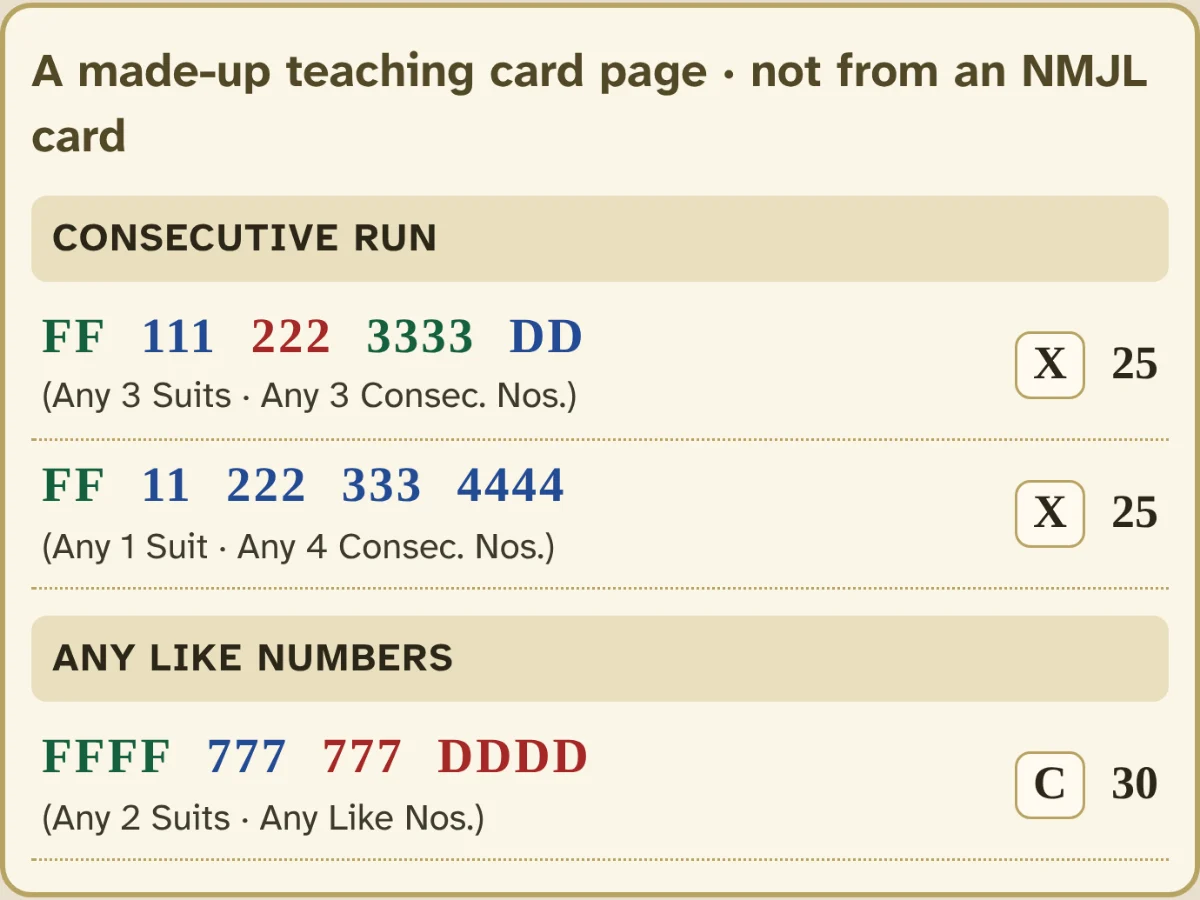
A new card comes out every spring. Chapter 3 teaches you how to read it.
Some exercises in this tutorial use our own teaching card. Its practice patterns are clearly labeled and are not part of the official NMJL card.
Step 5 How many tiles does the American set use?
Use this question to check what you’ve just learned. You can have another try.
You can use Back to read the explanation again.
Step 6 What counts as a win?
Your hand is the collection of tiles you’re playing with. You win by being the first to complete 14 tiles that fit one allowed pattern on the card.
A pattern is a little like a recipe: it lists the ingredients and how many of each you need. Matching tiles only help if they fit the whole pattern.
Example: a complete 14-tile hand
Our own teaching-card pattern · not a line from the official NMJL card
Two 1 Bams, followed by 3 each of the 2, 3, 4 and 5 Bams.
2 + 3 + 3 + 3 + 3 = 14 tiles.
Every group has exactly as many tiles as the pattern asks for.
When your hand legally completes a winning pattern, say “Mah Jongg!” and show your hand so the other players can check it.
Later chapters teach the card’s symbols and the rules for completing a hand. For now, remember: 14 tiles, one complete pattern.
Step 7 How a game goes
Here is a game from start to finish. You don’t have to do any of this yet; later chapters teach and practice each step.
Setting up and dealing
Mix the tiles face down and build 4 rows of stacked tiles, called walls. Each player takes 13 tiles, except the dealer, known as East, who takes 14.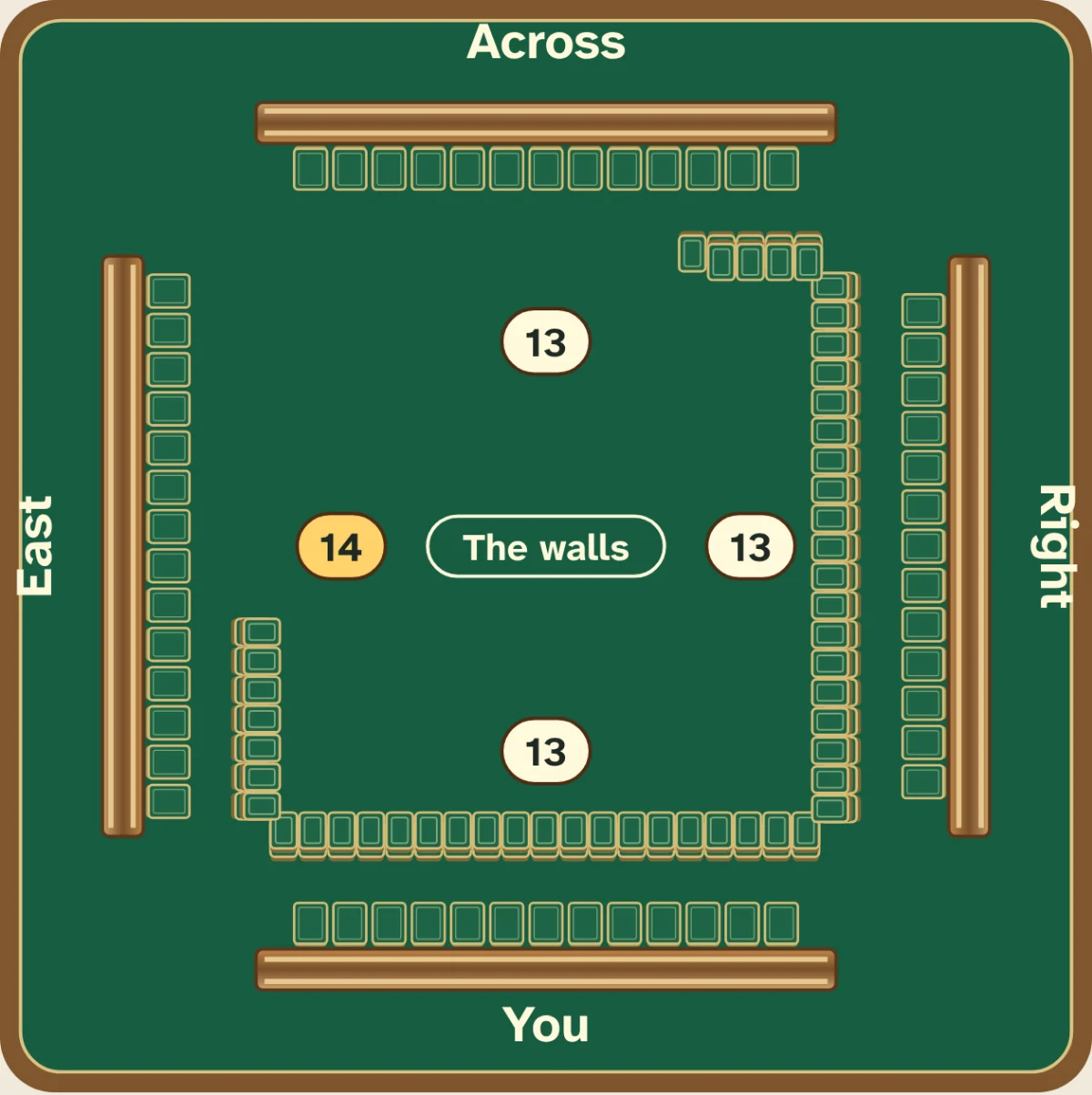
The walls in front of the racks, just after the deal. East holds 14 tiles; everyone else holds 13. Trading tiles: the Charleston
Before play, trade tiles in a set order. The first round has 3 passes, and a second round is optional. Chapter 5 covers the directions and the choices.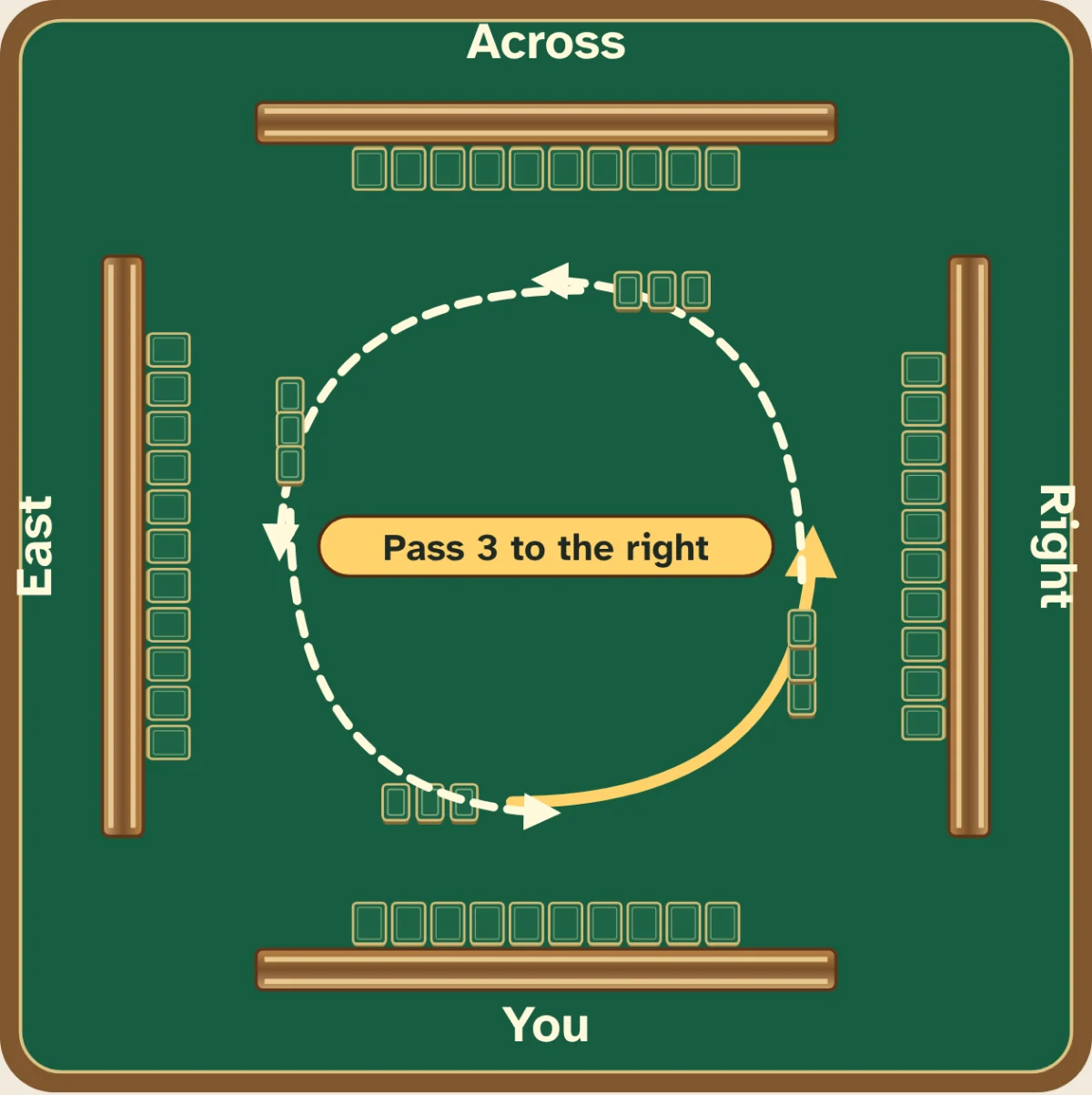
On the first pass, every player passes 3 tiles face down to the player on their right. Taking turns
East begins by discarding one tile, which means placing it face up in the center and saying its name. After that, on an ordinary turn you draw a tile, then discard one unless you win. To draw is to take a new tile from the wall. When the rules allow it, you can call for a tile another player discards, to complete an allowed group or to win.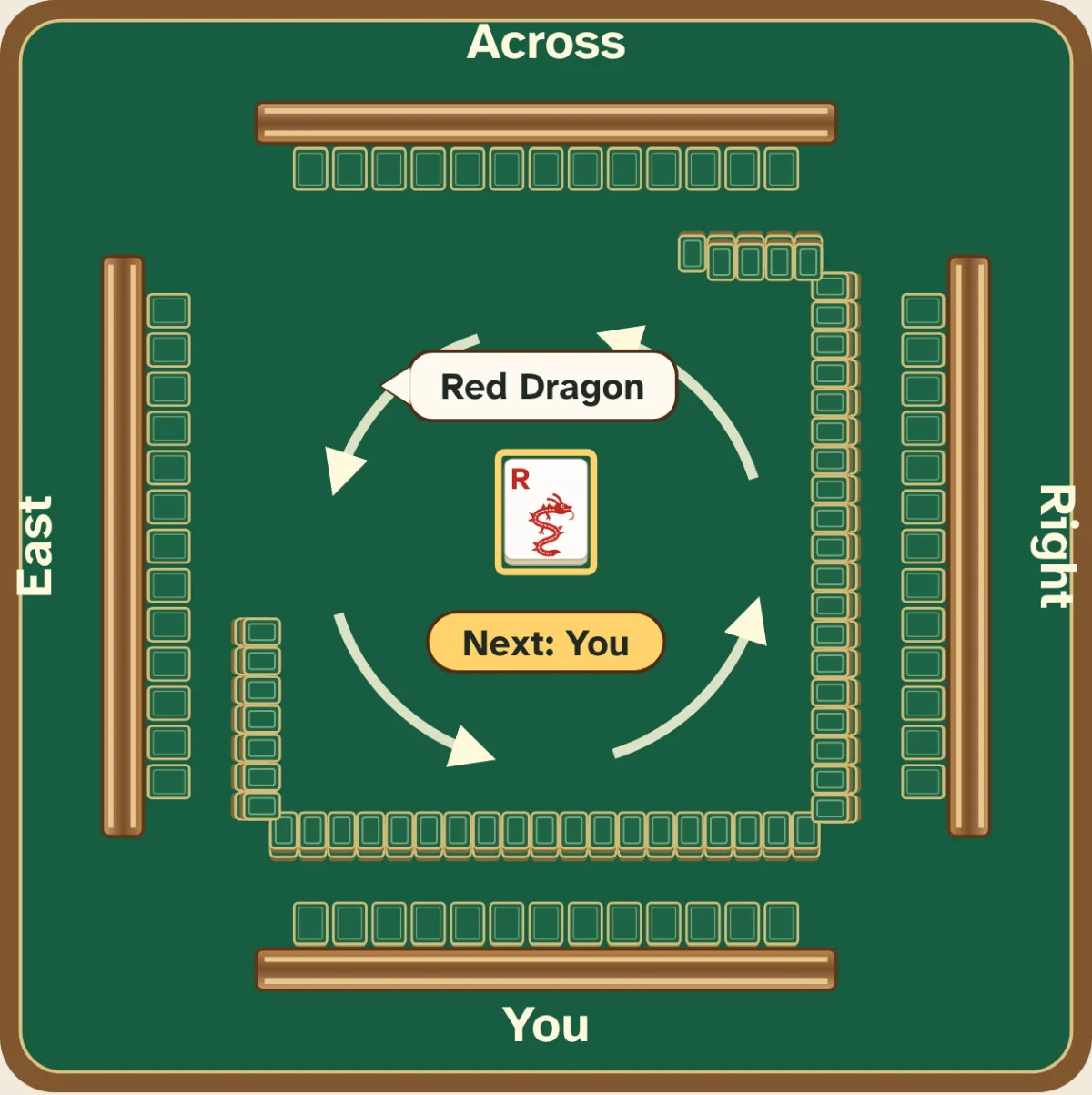
East’s first discard, named out loud. Turns go to the right, so you play next: draw a tile, then discard one. Completing a hand
The first player to hold a valid, complete pattern says “Mah Jongg!” and the others check the hand. A game can also end with no winner if the tiles in the wall run out.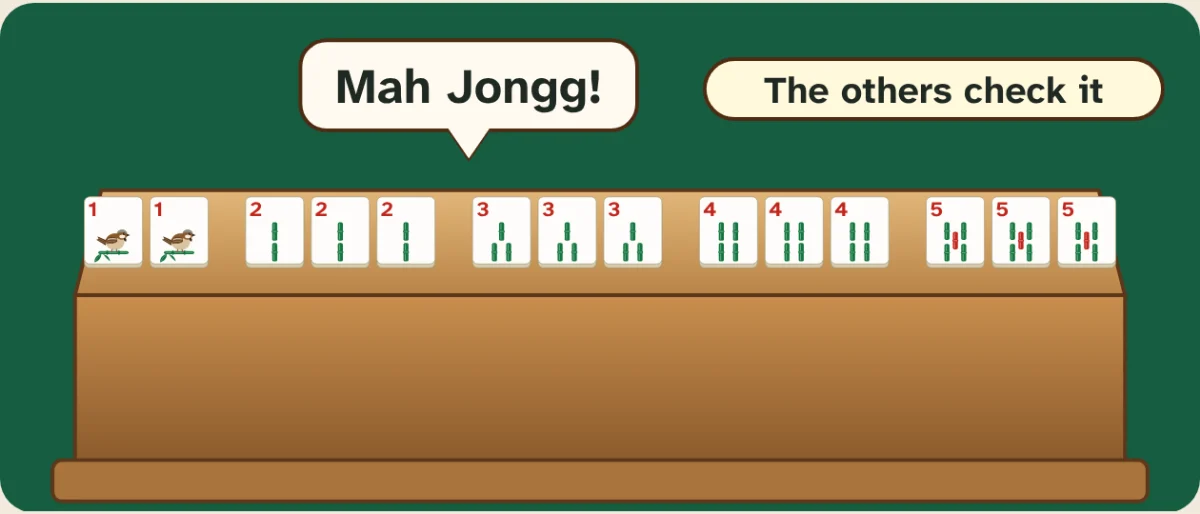
The winner says “Mah Jongg!” and lays all 14 tiles face up so the others can check them. Scoring, then another game
If someone won, work out the result from the hand’s value on the card and the payment rules. Groups may use money, tokens or a written score. Then mix the tiles and play again.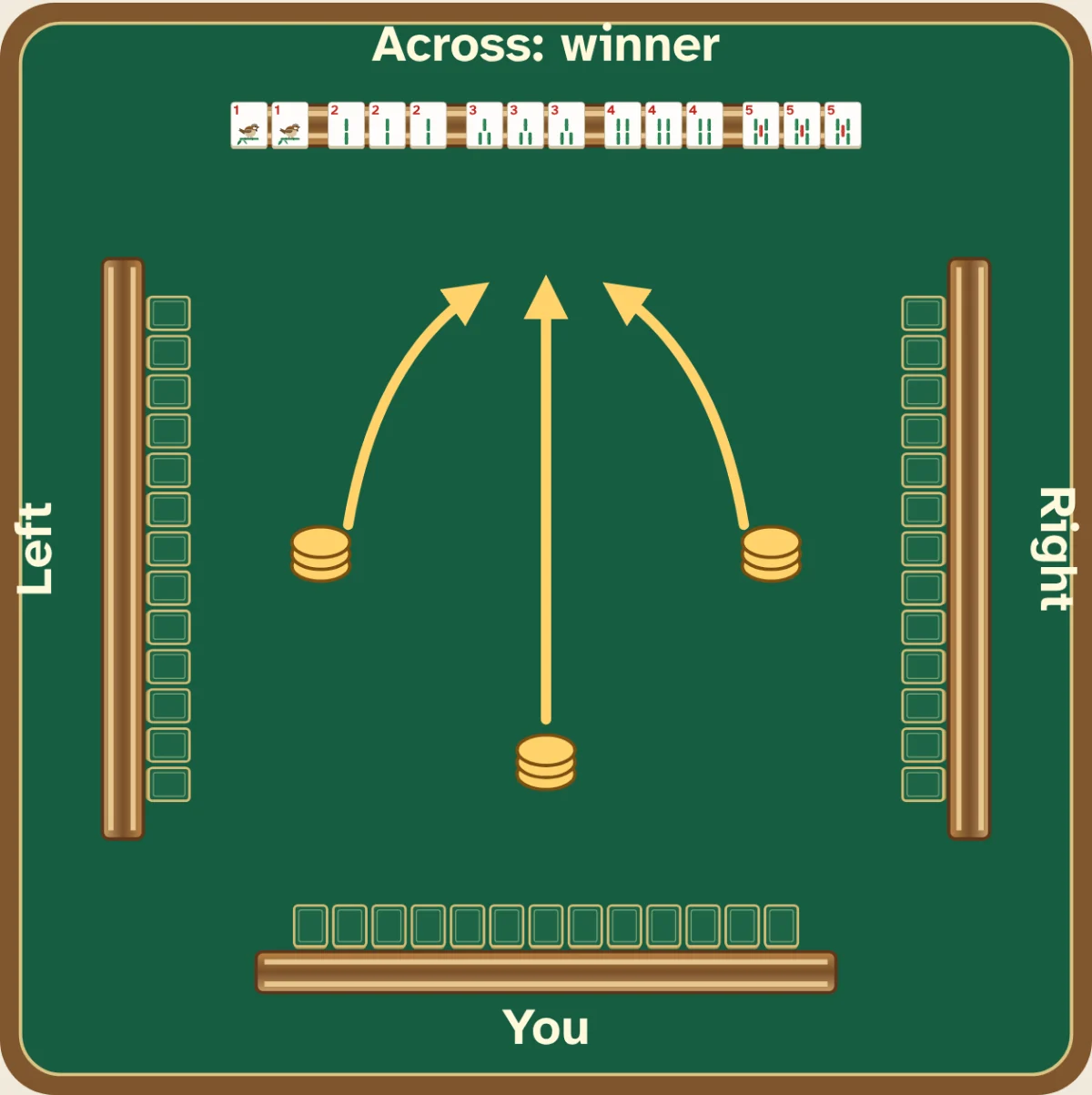
The other 3 players pay the winner. Chapter 8 shows how much.
Step 8 Things you need for a real game
You can carry on learning here without buying a thing. When you’re ready to organize a real game, here is what you’ll need.
- You plus 3 other players
This tutorial teaches the usual 4-player game. There are 3-player versions, but they follow different steps. - A set of American Mah Jongg tiles
You’ll play with 152 tiles, 8 of them Jokers. A boxed set may also hold spares. Make sure it has all the playing tiles, plus 4 racks and 2 dice. - A current card for every player
To play by NMJL rules, everyone needs the official card for the same year. Our teaching card is only for the exercises that name it. - A table with 4 chairs
Pick a surface big enough for 4 racks, the walls of tiles, the cards and an open playing space in the middle.
Allow time for learning
Set aside an unhurried couple of hours for your first get-together. While you’re learning, setting up, asking questions and checking the card can all take longer.
Step 9 Nice-to-have extras
These can make play more comfortable, but you don’t need any of them to begin the tutorial.
- A mat or table cover
A felt or neoprene surface gives the tiles a soft landing, keeps the noise down and helps protect the table. - Tile pushers
A pusher is a long bar for sliding a wall of tiles neatly toward the center. Some sets come with them. - Chips, tokens or a score pad
Decide together how you’ll keep score. You can practice the payment rules with tokens or on paper; you don’t need real money to learn. - Somewhere for food and drinks
A side table keeps food and drinks nearby and the playing surface clear.
Step 10 Your first games
Expect to pause, ask questions and check things as you go. That’s all part of learning the game.
- Take your time
Your first games may feel slow. Following the steps matters more than winning right away. - Practice the Charleston
Trading tiles can feel like a lot at first. Repeating the steps with guidance helps them become familiar. - Keep your card nearby
You can look at it any time during the game. There’s no need to memorize every pattern. - Ask if you’re not sure
Everyone makes mistakes. A patient group can explain a decision and help you try again. - Enjoy each other’s company
Learning alongside others is part of the experience. Make time for conversation and a sense of humor.
Step 11 Next up: the tiles
That’s the end of the introduction. Here are the ideas to take with you:
The usual game has 4 players.
The playing set has 152 tiles.
To win, you need 14 tiles that complete one pattern.
A rack holds your tiles; a card guides your hand.
Chapter 2 teaches you to recognize the tiles and sort them into their families.
Let’s meet the tiles.